
AI for market research: a step-by-step guide
Practical guide to using AI for market research: example prompts and a step-by-step process for every stage.
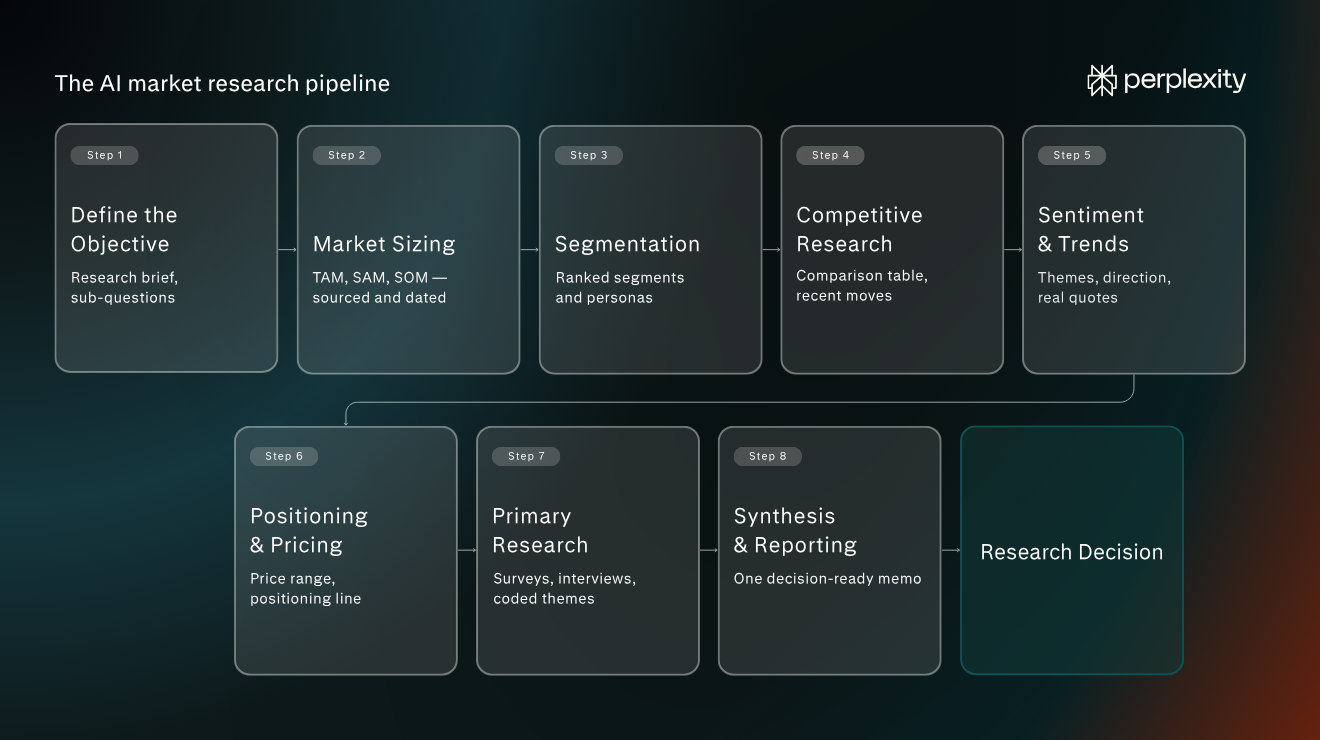
AI can now help run most of the market research process: sizing a market, tracking competitors, reading sentiment across reviews and forums. That holds whether the research is happening inside a two-person startup or a full marketing team. This guide walks through the full process, from defining the objective to final synthesis, with example prompts and workflow steps at each stage.
Use AI outputs as directional signals and always verify key claims against primary sources before making high‑stakes decisions.
Step 1: Define the research objective
Most market research starts with one broad question. The first job is turning it into something specific enough to actually research.
AI tools can help:
- Turn a rough idea into a structured research brief
- Break a broad question into specific sub-questions
- Identify what data or sources each sub-question needs
- Spot gaps or unstated assumptions in the original question
- Define what a clear, decision-ready answer looks like
- Suggest a realistic timeline or sequence for tackling the sub-questions
Example prompt:
"I'm evaluating whether to launch a subscription meal-kit product for a mid-size grocery chain in the Pacific Northwest. Turn this into a structured research brief. Include: (1) the core question, (2) three to five sub-questions, (3) the type of data or sources needed for each, (4) one sentence on what would count as a clear yes/no for each sub-question, and (5) flag any assumptions you’re making about the market or customer."
Step 2: Market sizing and landscape
Market sizing answers whether the opportunity is big enough to justify the rest of the process, before the research goes any further.
AI tools can help:
- Pull TAM, SAM, and SOM estimates from public data
- Identify adjacent or overlapping markets worth factoring in
- Flag figures that are outdated, contested, or sourced from a single estimate
- Cross-check numbers across multiple reports
- Break down a broad market by segment, region, or customer type
- Track how a market's size has changed over recent years
Example prompt:
""Estimate the TAM, SAM, and SOM for subscription meal kits sold through grocery retail partnerships in the Pacific Northwest. Use only sources published in the last 3 years. Pull from multiple sources, cite each figure with a direct quote or table reference, note the publication date, and flag where sources disagree or where a number is a single analyst's estimate rather than a market consensus. If you can’t find a reliable figure, say ‘no consensus’ instead of estimating."
Verification step:
Open each cited source and confirm the figure, date, and definition match your market boundary.
Step 3: Customer segmentation
Customer segmentation identifies who within the broader market is the actual buyer, since market size alone doesn't say who to build for or how to reach them.
AI tools can help:
- Build segment profiles from public data: demographics, behavior, spending patterns
- Identify which segments show the strongest signal for a given product or offer
- Draft personas grounded in real data rather than assumption
- Compare how needs and priorities differ across segments
- Flag segments that look attractive on paper but show weak underlying demand
Example prompt:
"Identify the main customer segments for subscription meal kits sold through grocery retail partnerships in the Pacific Northwest. For each segment, include: estimated size (or ‘unknown’ if not available), key demographics, primary motivations for buying, and price sensitivity. Distinguish observed data from inferred traits. Cite sources for any data points used."
Verification step:
Spot‑check at least one data point per segment (e.g., median income, adoption rate) against the original source.
Step 4: Competitive research
Competitive research shows who else is solving this problem and how a new entrant would need to differentiate.
AI tools can help:
- Build a fuller competitor list, including adjacent or indirect players easy to miss in a manual scan
- Compare positioning, pricing, and feature sets across companies
- Track recent developments, such as funding rounds, launches, partnerships, and leadership changes
- Summarize how a competitor talks about itself versus how customers or the press describe it
- Pull the comparison into a structured table instead of scattered notes
Example prompt:
"Identify the direct and indirect competitors to a subscription meal-kit product sold through grocery retail partnerships in the Pacific Northwest. Build a comparison table covering pricing, target customer, delivery model, and key differentiators. Include any funding, product launches, or partnership announcements from the last 12 months, with sources. For each event, include the month/year and the source name. If you’re unsure of a detail, mark it ‘unconfirmed’."
Verification step:
For each competitor, open the “About/Press/News” page or a trusted database entry to confirm the cited event and date.
Step 5: Positioning and pricing
Positioning and pricing decisions follow directly from the competitive map: where the gaps are, and what the market will actually pay to fill them.
AI tools can help:
- Analyze competitor pricing models and tiers
- Identify positioning gaps competitors haven't claimed
- Stress-test messaging against how competitors are already perceived
- Compare pricing against the willingness-to-pay signals surfaced in segmentation or sentiment research
- Draft positioning statements grounded in real differentiators
Example prompt:
"Using the competitive comparison table for subscription meal kits in the Pacific Northwest, identify pricing gaps and positioning angles competitors haven't claimed. Recommend a price range and a one-sentence positioning statement, and explain what evidence from the competitive research supports each recommendation. If evidence is thin or based on assumptions, say so and suggest a simple test to validate."
Verification step:
Cross‑check recommended price points against live competitor pages and any willingness‑to‑pay data from your primary research. If evidence is thin, present a testable range and plan a pricing experiment.
Step 6: Trend and sentiment analysis
Sentiment analysis surfaces demand, complaints, and unmet needs directly from how people talk about a category in reviews, forums, and social platforms.
AI tools can help:
- Scan reviews, forums, and social platforms for recurring themes
- Quantify how sentiment is shifting over time
- Separate a loud minority opinion from a broader pattern
- Identify emerging complaints or requests before they show up in formal reviews
- Pull representative examples instead of just a summary claim
Example prompt:
"Analyze customer sentiment toward subscription meal-kit services over the last six months, using reviews, Reddit threads, and social media posts. Identify the three most common complaints and the three most common praises, note whether sentiment on each is trending up or down, and include 2–3 short representative quotes per theme with sources. If a theme is based on a small or non‑representative sample, say so."
Verification step:
Manually review a sample of the quoted threads or reviews to confirm the theme and tone. Treat AI sentiment outputs as directional signals; accuracy drops on messy, real‑world text with sarcasm or mixed topics.
Step 7: Primary research
Primary research (such as surveys and interviews) closes the specific gaps that desk research couldn't answer.
AI tools can help:
- Draft survey questions based on the open sub-questions still unanswered from earlier stages
- Build a structured interview guide from the research objective and gaps flagged in sentiment analysis
- Code and summarise open-ended survey responses into themes
- Identify recurring themes across interview transcripts
- Suggest which unresolved questions are better suited to a survey versus an interview
Example prompt:
"Based on this research brief and the gaps flagged in the sentiment analysis, draft a 10-question customer survey to test willingness to pay and preferred delivery frequency for a subscription meal-kit product. Include a mix of scaled and open-ended questions, and note which questions map to which unresolved sub-question from the brief. Avoid leading questions and keep wording neutral. Flag any question that might need domain review before fielding."
Verification step:
Have a domain expert review the draft instrument for clarity and bias before fielding. Use a dedicated survey or interview tool to collect data. AI analyses responses after collection, it does not replace data collection.
Step 8: Synthesis and reporting
Reporting takes the objective, market sizing, competitive research, and sentiment analysis and turns them into a single, decision-ready answer.
AI tools can help:
- Pull findings from every stage into a single document
- Surface contradictions between sources or between stages
- Draft an executive summary built from the underlying research
- Flag where the evidence is thin and more research is needed before deciding whether or not to proceed
- Organize findings around the original sub-questions, so it's clear which ones got answered and which didn't
Example prompt:
"Using the attached research brief, market sizing estimates, competitive comparison table, and sentiment analysis, synthesize the findings into a one-page decision memo. Lead with a clear recommendation, support it with the strongest evidence from each section, flag any contradictions between sources, and note which findings would benefit from additional research. Add a short ‘confidence’ note for each key claim: high (source-verified), medium (multiple consistent sources), or low (single/uncertain source)."
Verification step:
Add a “confidence & verification” section to the memo: list which claims are source‑verified, which are ranges/estimates, and which need primary research before a go/no‑go. Open a sample of high‑stakes citations to confirm they support the claim as written.
Accuracy checklist to use before treating any section as decision‑grade
- Source trace: Can you follow each statistic or claim to a specific, named source?
- Source open: Does the source actually say what the AI claims?
- Date check: Is the underlying source current enough for your decision window?
- Definition match: Do the market boundaries, customer definitions, and pricing tiers make sense in the context of your proposed product?
- Human spot‑check: For sentiment and competitor moves, manually review a sample of quotes or press items to confirm patterns.
Keep your research fresh
Market research goes stale quickly. Treat this workflow as an ongoing system, not a one‑off project, by rerunning each stage on a predictable cadence.
Research stage | Light refresh | Deep refresh | Run an additional refresh… |
Market sizing | — | Every 6–12 months | Before major funding rounds, launch decisions, or board reviews |
Competitor tracking | Monthly (pricing, features, hiring signals) | Quarterly (full competitor table, funding/partnerships) | After notable competitor announcements or market shocks |
Sentiment | Weekly or monthly (alerts on key themes) | Before major product, positioning, or price changes | Ahead of launches, rebrands, or pricing tests |
Primary research | Ad‑hoc surveys/interviews to test specific hypotheses | Before major pivots, new segments, or significant price changes | When entering new markets or revising core offers |
Single vs. multi-step research
Some of the work above is a single well-built query. Some of it needs an iterative back-and-forth. Knowing which is which saves time and avoids treating a shallow first pass as complete.
A first-draft competitor list or a one-time sentiment scan is usually a single query. Tracking a competitor's moves over months, or narrowing a market-sizing estimate that has conflicting sources, takes a sequence of queries that build on each other: an initial pass, a follow-up that checks a specific claim, another that fills a gap the first one missed.
Single query example: “What are the top 5 meal‑kit brands in the US by revenue in 2025?”
Multi‑step example: “What is the realistic SOM for our specific grocery‑partnership model in the Pacific Northwest, given conflicting TAM estimates and limited regional data?”
As a rough guide: single query when the question has one clear answer to look up. Multi-step when the answer depends on comparing multiple sources, tracking something over time, or the first response raises a new question worth chasing down.
Which type of AI tool do you need for market research?
Not every AI tool is built the same way. Some answer a question directly from a single query. Others run multiple steps on their own, searching, cross-checking, and compiling before returning anything.
Stage | Tool to use | What to check |
Market sizing | Deep-research or agentic tool, given the multiple sources involved | Are figures dated, and does the tool flag disagreement between sources? |
Segmentation | General-purpose assistant for a first pass, deep-research tool to build out full profiles | Is the data behind each segment real, or inferred from assumption? |
Competitive research | Deep-research or agentic tool for a full landscape scan | Does the competitor list go beyond the two or three obvious names? Is the information current? |
Positioning and pricing | General-purpose assistant, working from an existing competitive table | Is the recommendation tied to specific evidence, or just plausible-sounding? |
Sentiment analysis | Tool with access to current reviews, forums, and social platforms | Is the sentiment based on a real sample, or a handful of cherry-picked posts? |
Primary research | General-purpose assistant for drafting; a tool built for response analysis when volume is high | Does the draft need domain review before it's fielded? |
Putting this into practice
Perplexity supports this process end to end. Deep Research pulls from hundreds of sources for sizing, competitive, and sentiment work in a single session, with citations on every figure.
Spaces keeps a research brief, source documents, and prior findings in one place across every stage, so each new query builds on what came before instead of starting over.
Try Perplexity for market research.
FAQs
How do you use AI for market research? AI can help at every stage: turning a broad question into a research brief, sizing a market, researching competitors, analyzing customer sentiment, drafting survey questions, and synthesizing findings into a decision memo. Each stage benefits from sourced, cross-checked output rather than a single unverified answer.
What is the best AI tool for market research? It depends on the task. A general-purpose assistant handles single-query work like a first-pass competitor list or a positioning draft. Tasks that involve cross-checking many sources or tracking something over time, like market sizing or ongoing sentiment analysis, need a deep-research or agentic tool built for multi-step queries.
How accurate is AI market research data? Accuracy depends on the sources behind it. A well-built query asks for publication dates and flags conflicting figures, but any single AI-generated number is only as reliable as its source, which is why cross-checking across multiple reports matters at every stage, not just sizing.
Do I need existing data to start AI market research? No. A research objective can be built from a rough idea and a few known constraints, like target geography, price range, or customer type. AI can work from that starting point, and each stage's findings become the input for the next.