
The AI literacy gap is growing. Here’s how to close it.
Learn what AI literacy is and how to build it with hands-on practice, checking sources, and evaluating AI output safely.
What is AI literacy?
Being AI literate is having the ability to understand how AI works well enough to use it effectively, recognise its limits and risks, and make informed decisions about its output. Digital Promise’s AI Literacy Framework describes it as a combination of understanding, using, and evaluating.
But the most important piece, what separates the novice from the expert, is evaluation. Sadly, it often gets little practical attention in mainstream training. After a two-hour workshop, just about anyone could use AI to generate a polished response to a question.
But being AI literate means someone has the ability to tell if the response is:
- Accurate
- Complete
- Current
- Relevant
- Safe to act on
Why AI literacy matters now
AI has become widely available, but the support and training to learn how to use it well is harder to find.
- Some 6.1M US workers are in jobs with both high AI exposure and low capacity to adapt to a job transition, says recent research from Center for Governance of AI fellow Sam Manning
- 38% say their organisation has adopted AI, but only 12% use it daily, according to Gallup’s Q4 2025 survey.
That gap, between access to AI and confident use, creates an opportunity for both individuals and businesses to give themselves a leg up with AI literacy training that covers more than just learning how to write better prompts.
At the same time, McKinsey reports that demand for AI fluency, the ability to use and manage AI tools, grew nearly sevenfold from mid-2023 to mid-2025.
- Employers clearly recognise the need for AI literacy training.
- Workers want to gain the skills.
But there’s concern when maximum adoption is the only success metric. People can learn to use AI quickly, but becoming a careful, proficient user takes time and practice.
Evaluation: the most important skill
Lots of AI training stresses the importance of evaluating output, but doesn’t spend much time (if any) covering what that actually means.
In practice, AI verification requires three key behaviours:
- Reading carefully
- Asking hard questions
- Taking the time to double-check sources, stats, and claims.
Before acting on the information AI provides, decide whether or not it meets the following criteria:
- Can it be traced to a reputable source?
- Does it hold together when individual parts are checked?
- Is it current enough to be relevant?
While the writing that AI generates may sound polished and professional, the facts may be wrong. AI can “hallucinate” by making things up entirely (Read How to Spot AI Hallucinations: 7 Red Flags), finding incorrect or incomplete information, or by misunderstanding what it finds and coming to a false conclusion.
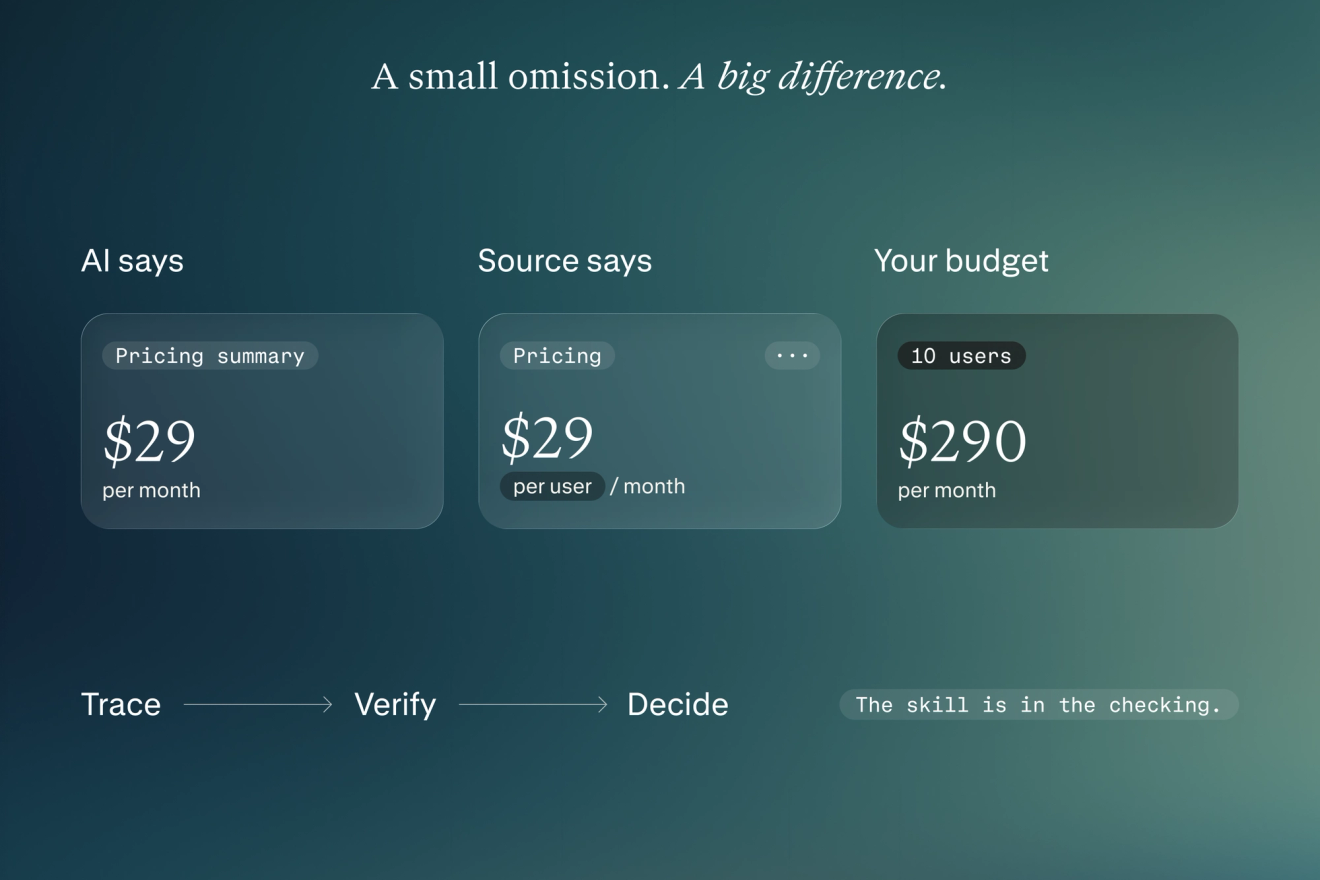
To evaluate any output, follow this process:
Trace → Verify → Decide.
For example, ask AI to draft a comparison of competitor pricing. To evaluate the results:
- Open every pricing page (trace)
- Check plan names and pricing (verify)
- Record what the AI got wrong or left out, and make any necessary corrections (decide)
Here are some more examples of how to evaluate AI output.
Type of AI claim | Example of a claim an AI might make | What to check before using it |
Factual claim | “The U.S. Small Business Administration offers grants of up to $50,000 for new retail businesses.” | Confirm the programme actually exists, eligibility requirements, current amount, application deadline, and whether it is a grant rather than a loan or local programme. |
Citation or quotation | “A 2025 Gallup survey found that 62% of customers prefer AI-powered support.” | Open the cited source. Check that it’s real, recent, correctly attributed, and actually supports the exact statistic and wording. |
Legal or regulatory assertion | “Your company must retain customer chat records for seven years.” | Verify the jurisdiction, industry, record type, and current legal rule with authoritative guidance or qualified counsel. AI may flatten state, federal, international, or sector-specific requirements into one false universal rule. |
Tax or financial guidance | “You can deduct the full cost of this equipment in the year you buy it.” | Confirm the relevant tax year, business entity, purchase type, limits, and accounting treatment with IRS guidance and a tax professional. |
Calculation or forecast | “If conversion rises by 15%, annual revenue will increase by $180,000.” | Recalculate the maths and scrutinise the assumptions: current traffic, baseline conversion rate, average order value, churn, sales capacity, seasonality, and whether “15%” means percentage points or relative growth. |
Summary of a source document | “The contract permits termination with 30 days’ notice.” | Read the original clause and linked provisions. AI can omit exceptions, notice requirements, renewal provisions, remedies, or definitions that change the practical meaning. |
Recommendation | “You should automate refund approvals to save staff time.” | Decide whether the workflow is reversible, whether errors could hurt customers or finances, what approval thresholds are appropriate, and who owns exceptions. A sensible-sounding recommendation still requires business judgement. |
Why most AI training fails to build literacy
In just a few years, AI has evolved from a specialised technology to a ubiquitous topic and tool. As business and government leaders have rushed to find training resources, vendors have rushed to create them. Demand has been high, but expertise is thin, and the quality of available materials hasn’t always kept up.
The result is training theatre that barely skims the surface of important topics, and delivers one-size-fits-all instruction presented as a single event. Be sceptical of training where:
- The focus is on familiarity with the tools and how to write prompts. That kind of workshop teaches awareness, but not the discernment that comes with having to complete actual workflows.
- Content doesn’t cover the deeper, more important questions of when to use AI, when not to, how to evaluate output, or how to apply company rules to real tasks.
- There’s not enough practice time, a lack of task-specific instruction, and no feedback on how participants are doing or what they could improve.
- Attendance is the goal, rather than competence.
How to actually build AI literacy
To become AI literate, people need hands-on, role-specific training that requires them to complete actual tasks in a realistic workflow. And they need dedicated time to do it.
- Hands-on training provides real practice that helps people learn what to do in various situations in a low-risk environment. When evaluation and correction are part of the workflow, participants learn from their own and each other’s experiments and mistakes. Get started by signing up for one or more AI tools, even at the free level.
- Role-specific training is crucial because understanding and judging different outputs requires different skills. People who’ve never created a pivot table spreadsheet would have a hard time knowing whether an AI made a good one, or how to prompt it to do a better job the second time around. The same goes for evaluating legal documents, imagery for a website, a summarisation of recent medical research, or any job-specific output that requires some background knowledge. Begin by identifying some regular tasks that could be done with AI.
- Assigning real tasks helps people understand how AI can help them do their jobs and build the skills they’ll need to use it. They’ll learn what tasks are suitable for AI to do on its own, which call for more supervision, and what always needs human judgement, as well as when and how to keep confidential customer and company data secure. Think about categorising tasks according to how much human review they require. For example:
AI can do solo | A person should review | A person must own |
Initial drafts, document summaries, categorisation, research leads, data gathering | Claims, citations, customer-facing language, calculations, external communications | Hiring, payments, contracts, legal/tax decisions, sensitive data access and storage |
- Protected time is the final piece required for building AI literacy, at least at the outset. Everyone’s busy, which always seems like a good reason to keep doing things the old-fashioned way instead of taking extra time to try using a new tool. Like many good investments, the time spent training will more than pay off once people understand how to best partner with AI. Set aside some time each day or week to spend, either alone or with a group.
Where to learn
There are many resources available online that provide good foundational training. Look for those that ask you write and revise prompts, compare outputs, verify claims, identify missing context, and decide when an answer needs a human to review it. Here are some places to start:
- Chalmers University of Technology offers Working and learning with generative AI, a free online course that combines self-study with optional live sessions. Exercises are tailored to different professions, focus on real-life tasks, and progress from effective individual use to task delegation.
- DeepLearning.AI’s Generative AI for Everyone is an online class led by AI pioneer Andrew Ng. It provides an overview of generative AI, how it works, and what it can do. It also offers hands-on exercises to help you learn the basics and beyond.
- Perplexity.ai can also support the kind of training these resources, and this article, recommend: practice asking realistic questions, inspecting the evidence behind factual claims, comparing sources, and refining work with human review. For web-based research results, output includes linked citations that make it easier to trace claims, stats, and quotations back to their source. Additionally, visit Perplexity Academy for a collection of short, how-to videos about basic topics like best-practices for writing prompts, as well as more advanced topics such as creating reusable workflows for regular tasks and connecting Perplexity to business tools.
For further suggestions on learning to evaluate AI, download our guide about establishing a framework for trust, accuracy and oversight. For information tailored to different industries and purposes, including example queries for specific tasks, explore all our guides here.
AI literacy is built through practice, in actual workflows. Workshops may help kick things off, but they are not a substitute for doing real work in an AI tool, evaluating the output, correcting mistakes, and applying human judgement. With hands-on, role-specific training completing relevant tasks in protected sessions, AI will begin to deliver impressive returns.
Frequently asked questions
What is the meaning of AI literacy?
AI literacy is the ability to understand, use, evaluate, and make informed decisions about AI systems and their output. That goes beyond just writing successful prompts. AI-literate people can recognise where AI is useful, protect sensitive information, check important claims, understand the limits of an answer, and know when a person must make the final decision.
What is an example of AI literacy?
An example of AI literacy is using an AI tool to draft a competitor analysis, then opening every cited source to verify prices, product features, dates, and quotations before using the analysis in a sales presentation. The most important part of literacy is the ability to spot what needs checking, validate it against reliable evidence, and revise or discard unsupported claims.
What are the four pillars of AI literacy?
AI-literacy frameworks use different terminology, but a practical three-part model is understand, use, and evaluate. An AI-literate person understands how AI works and where it can fail, uses it effectively for appropriate tasks, and can evaluate output for accuracy, bias, completeness, timeliness, and risk. Frequently included is also the ability to engage responsibly by protecting data, considering people affected by AI use, and maintaining human accountability. Evaluation is the most important piece, and what separates expert users from beginners.
How can I improve my AI literacy?
Improve AI literacy by practising with real, low-risk work. Tutorials are helpful, but they are no substitute for hands-on practice. Choose an AI tool and a repeatable task, such as summarising a document, researching a competitor, or organising notes. Then review the output carefully by tracing where information came from, verifying important facts and citations, and correct any errors. Over time, build the habit of deciding which tasks AI can assist with, which need human review, and which should be reserved with humans. The goal is to use AI confidently, safely, and with sound judgement.
How do you evaluate AI output?
Start with the claims that matter most. Check whether the source exists and supports the exact statement. Confirm that names, dates, products, and figures are correct and presented accurately. Make sure the information is current. Involve a qualified reviewer for legal, medical, financial, security, employment, or other high-stakes decisions. AI-generated citations can make the process faster, but a citation should still be opened and checked.