
How to use AI for studying: 5 methods that work
Turn AI into a study partner with quizzes, spaced review and prompts that build recall instead of giving you the answers
Introduction
AI can help with studying, but only when it's used the right way. Five methods have real research behind them:
- Retrieval practice: Quiz yourself on the material instead of rereading it
- Distributed practice: Spread your studying out over several days instead of cramming
- Self-explanation: Explain a concept in your own words before reading someone else’s explanation
- Interleaving: Mix it up with different types of problems in one session instead of doing one type of problem at a time
- Metacognitive review: Check what you can do without help instead of just focusing on what feels familiar
When used well, AI can successfully run all five, turning a chatbot into a study partner instead of a machine that just responds to your questions. When people don’t use AI correctly as a study aid, it becomes a quick way to feel falsely prepared.
Most students aren't using AI as a study practice partner yet. But 57% of US college students use AI in their coursework at least weekly, and about 1 in 5 use it daily (Gallup/Lumina Foundation, 2026).
In the UK, 95% of undergraduates now use AI in some form, up from 66% just two years ago (HEPI, 2026). As the use of AI increases, people are focused on using it properly to make sure it’s actually going to be helpful.
The test that really matters shows up in every method below. After closing the chat, a student should be able to retrieve, explain, and apply the material without help.
Yes, AI helps with studying when it creates retrieval, feedback, spacing and reflection. It can raise practice performance substantially, but students who use it as an answer shortcut can score lower on later unassisted tests than peers who never used AI at all. The method used matters more than the tool itself.
How to use AI for studying in five steps
- Ask for questions before answers. Turn AI into an interactive quiz, not a summarising tool.
- Schedule repeat practice. Space out sessions instead of cramming everything in all at once.
- Explain the idea back. Write out an explanation on your own before reading the answers and ideas from AI.
- Mix problem types. Shuffle categories instead of blocking them and only focusing on one, with the exception of vocabulary.
- Check your performance without AI. This is the only real test that will tell you whether or not studying with AI actually worked.
AI helps people build the practice environment, but the learning still happens in the student's head.
What the research actually says about studying with AI
The best evidence comes from a 2025 randomised field experiment in the Proceedings of the National Academy of Sciences PNAS (Bastani et al.), run across roughly 1,000 secondary-school maths students over the span of four practice sessions. The three conditions only make sense read together, not as a single headline number:
Condition | Result |
Standard (plain and unmodified) GPT-4 access | Grades went up 48% |
Guardrailed tutor (hints, not full solutions) | Grades went up 127% |
Access removed after the practice sessions ended | Standard-access group scored 17% lower than students who had never used AI at all |
Scope note: This is a secondary-school maths study. The exact percentages shouldn't be generalised to other subjects or age groups, but the underlying pattern (design determines outcome) shows up across the rest of the research base, too.
The gap between the two access conditions tells the whole story. Students with unrestricted AI access improved, then fell behind once the tool was removed, most likely because they had outsourced the reasoning rather than practised it.
Students given a version that withheld full solutions and offered hints instead improved more than twice as much, because the tool was structured to make them do the work.
A separate review that pooled 35 studies and 4,193 participants found that, on average, students who studied with AI learned moderately more than those who didn’t. But the results varied depending on the subject, how long students used AI, and how they used it (Zhu, 2026).
That fits with the PNAS finding: AI-assisted studying isn't reliably good or bad on its own. Rather, it depends on whether it's built to prompt retrieval or to shortcut it.
The takeaway: what really matters is how students work with AI to study, not the fact that they’re using it in the first place.
Method 1: Make AI test you (retrieval practice)
What it is: Testing yourself on the material instead of rereading or summarising it.
Why it works: Practice testing is rated as "high utility" across ages and abilities (Dunlosky et al., 2013). Recall tests, where students have to produce the answer from scratch, lead to greater retention than recognition tests such as multiple choice, where the answer is already in front of the student (Rowland, 2014).
Workflow:
- Give the AI a specific course scope (syllabus, notes, chapter range)
- Ask for one free-response question at a time, not a full quiz
- Answer before asking for hints
- Ask for feedback that names the first wrong step, not a rewritten answer
- Re-test anything that was missed a day or two later
Copy-ready queries to use:
"Using [my notes/syllabus], ask me one open-ended question at a time about [specific topic]. Don't show me the answer. After I respond, tell me only where my reasoning went wrong. Don't give me the full correct answer unless I ask."
⚠️ Failure mode: Asking AI to create a full quiz with the answers already visible, then reading both columns. This feels like studying but ultimately skips the retrieval step that makes the technique work.
✅ Independent check: Close the chat. Answer three of the missed questions from memory, with nothing open.
Method 2: Space it out (distributed practice)
What it is: Spreading study sessions apart over days instead of concentrating them into one long cram session.
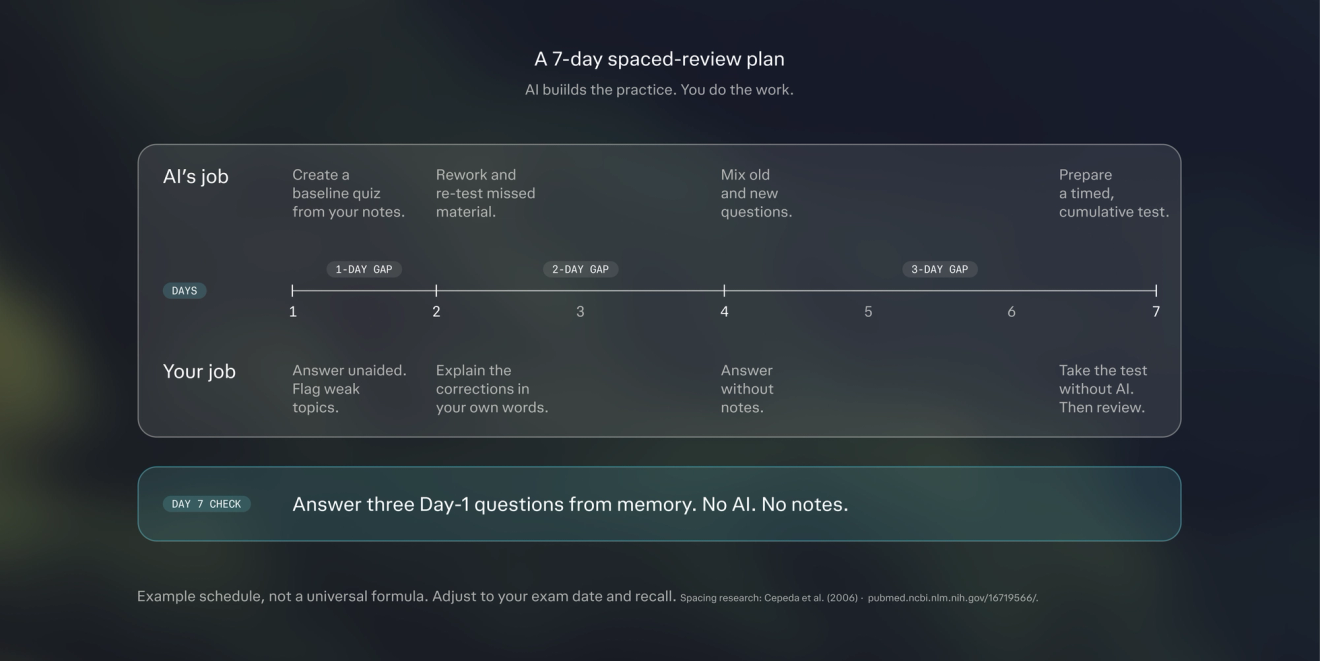
Why it works: Spaced-out practice consistently beats cramming, and the ideal gap between sessions grows as the exam date gets further away. There's no single universal schedule (Cepeda et al., 2006), so the table below is a starting structure, not a formula.
One-week spaced-review plan:
Day | AI's job | Student's job |
1 | Baseline quiz from notes | Answer without help, flag weak topics |
2 | Re-tests missed material, reworded | Explain each correction in your own words |
4 | Mixes old and new questions | Answer without notes |
7 | Timed cumulative test | Complete without AI, then review |
Copy-ready query:
"Build me a 7-day spaced review plan for [topic] based on [my notes]. Day 1: baseline quiz. Day 2: re-test what I missed, reworded. Day 4: mix old and new questions. Day 7: timed cumulative test."
⚠️ Failure mode: One long cramming session the night before a test that never tests delayed recall. Spacing out your studying is designed to strengthen this.
✅ Independent check: On Day 7, after the AI's cumulative test, answer three Day 1 questions from memory. No AI, no notes.
Method 3: Explain it back (self-explanation)
What it is: Generating an explanation of a concept before reading someone else's version of it.
Why it works: A review of 64 studies found that students learned more when they were prompted to explain a concept in their own words. In most of those studies, a teacher wrote the prompts, and the researchers said computer-generated prompts required more studying (Bisra et al., 2018). AI can now do that job, as long as the student explains the concept before the AI does.
Workflow:
- AI gives a concept, with no explanation attached
- Explain it before seeing AI's version
- AI marks the explanation as correct, incomplete or confused
- AI asks one targeted follow-up question on the specific gap
- Rewrite the explanation without copying AI's language
Copy-ready query:
"Give me the name of a concept from [topic] with no explanation. I'll explain it back to you in my own words. Tell me if my explanation is correct, incomplete, or confused, and ask one follow-up question about the weakest part."
⚠️ Failure mode: Asking AI to simplify the concept before attempting an explanation on your own first.
✅ Independent check: A two-minute teach-back, out loud, no notes, no chat open. If it can't be said out loud, it won't hold up in a test either.
This is where "practice environment, not an answer machine" matters most. AI should catch the gap in the explanation, not supply one that was never built in the first place.
Method 4: Mix problem types when it helps (interleaving)
What it is: Shuffling problem types within a single study session instead of blocking them by category. For example, a student should work through mixed algebra and geometry problems instead of finishing all of the algebra first.
Why it works: Mixing problem types helps students learn moderately more than practising one type at a time. The benefit was a bit smaller for maths, but for vocabulary and word learning it flipped: students did better practising one category at a time (Brunmair & Richter, 2019). That means that when it comes to studying with AI, mixing is a good default for problem-solving subjects and a bad one for flashcard-style memorisation.
Workflow:
- AI mixes problem types without labelling which category each belongs to
- Decide the approach before solving, based on recognising the problem type
- Feedback covers the choice of method separately from whether the final answer was correct
Copy-ready query:
"Give me a mixed set of problems from [these topics] in random order, without telling me which topic each is from. After each answer, tell me separately whether I used the right approach and whether the final answer was correct."
⚠️ Failure mode: Applying interleaving to vocabulary lists or flashcard-style facts, where evidence favours blocked, spaced review instead.
✅ Independent check: After a mixed session, name which problem type was slowest, and why.
Method 5: Track whether it's working (metacognition)
What it is: Monitoring what's actually known versus what just feels familiar after reading it or hearing it explained.
Why it works: When students are asked to stop and check their own understanding, they take more control of their studying and learn more. The benefit is bigger when the feedback is tailored to their specific mistakes (Guo, 2022).
Studying that feels easy can fool you into thinking you've learned more than you have (Bjork & Bjork, 2020), and with a clear AI explanation that makes sense in the moment, the information will feel learned.
Three questions to ask yourself:
- What can I explain without AI?
- Which error did I repeat?
- What should I re-test tomorrow?
Copy-ready query:
"Review my last study session with you. Based on what I got wrong and where I hesitated, tell me: what do I actually seem to understand, what error did I repeat, and what should I re-test tomorrow?"
⚠️ Failure mode: Treating "that made sense when AI explained it" as proof of learning. Fluency and retention aren't the same thing.
Note: This doesn't mean making everything harder just for the sake of making it hard. Added difficulty only helps once the background knowledge is already there.
Check before memorising it: verification
Before putting anything AI says onto a flashcard, run it through three checks:
- Traceability. Can the original source be opened?
- Consistency. Does a second, independent source agree?
- Currency. Is this the kind of fact that changes over time, and could it be outdated?
Course material (the textbook, the lecture, the syllabus) is the primary source, not AI's summary of it. Confirm that the cited passage exists where AI says it does, cross-check it, then save the corrected version.
⚠️ Failure mode: Rehearsing AI-generated flashcards before verifying the facts on them.
For a deeper look at spotting bad AI output, see [how to spot AI hallucinations].
Choose a tool by study job
Rather than ranking tools, match the tool to the job:
Study job | Tool category | What to look for |
Research and explanation | Grounded answer engine | Visible citations, source access |
Course-specific review | Source-grounded notebook | Answers limited to uploaded material |
Long-term recall | Spaced-repetition system | Scheduling, editable cards |
Guided problem solving | Tutor mode | Questions and hints before answers |
Lecture review | Transcription tool | Accurate transcript, easy correction |
For research and explanation, an AI personal assistant can be helpful. To organise source material before starting any of the methods above, a guide on organising study materials walks through it.
Check the course policy
Rules vary by school, and often vary by assignment within the same class. 42% of US students say their school discourages AI use, 11% say it prohibits it outright, 35% say it encourages it with limits, and 7% say it encourages it freely (Gallup/Lumina, 2026). When in doubt, ask your teacher or lecturer before submitting anything AI has touched.
Conclusion
Think of AI like an electric bike, not a robot vacuum cleaner. On an electric bike, the rider is still pedalling, steering and fully aware. The AI just multiplies the effort.
The test doesn't change depending on which method is used, and that’s a good thing. After closing the AI, can the student retrieve, explain or apply the material independently? That’s the important question.
FAQs
Does using AI to study actually help learning?
Yes. A meta-analysis of 35 studies found a moderately positive effect (g = 0.670) (Zhu, 2026). But in one field experiment, students with unrestricted AI access scored 17% lower on a later unassisted test than peers who'd never used AI at all (Bastani et al., 2025). Method matters more than access.
Is using AI to study cheating?
It depends on the course policy. Studying with AI-generated questions is practice, not submitted work. 42% of US students say their school discourages AI and 11% say it prohibits it (Gallup/Lumina, 2026). Check the syllabus first.
What should you ask AI for instead of a summary?
A free-response quiz (retrieval practice), a self-explanation check (explain it back) or a spaced review plan (distributed practice). All three require you to produce the answer, instead of just reading one someone else produced.