
AI maturity: what it means for your organisation
Learn the stages of AI maturity, what separates adoption from integration, and how to assess where your organisation stands.
What AI maturity means
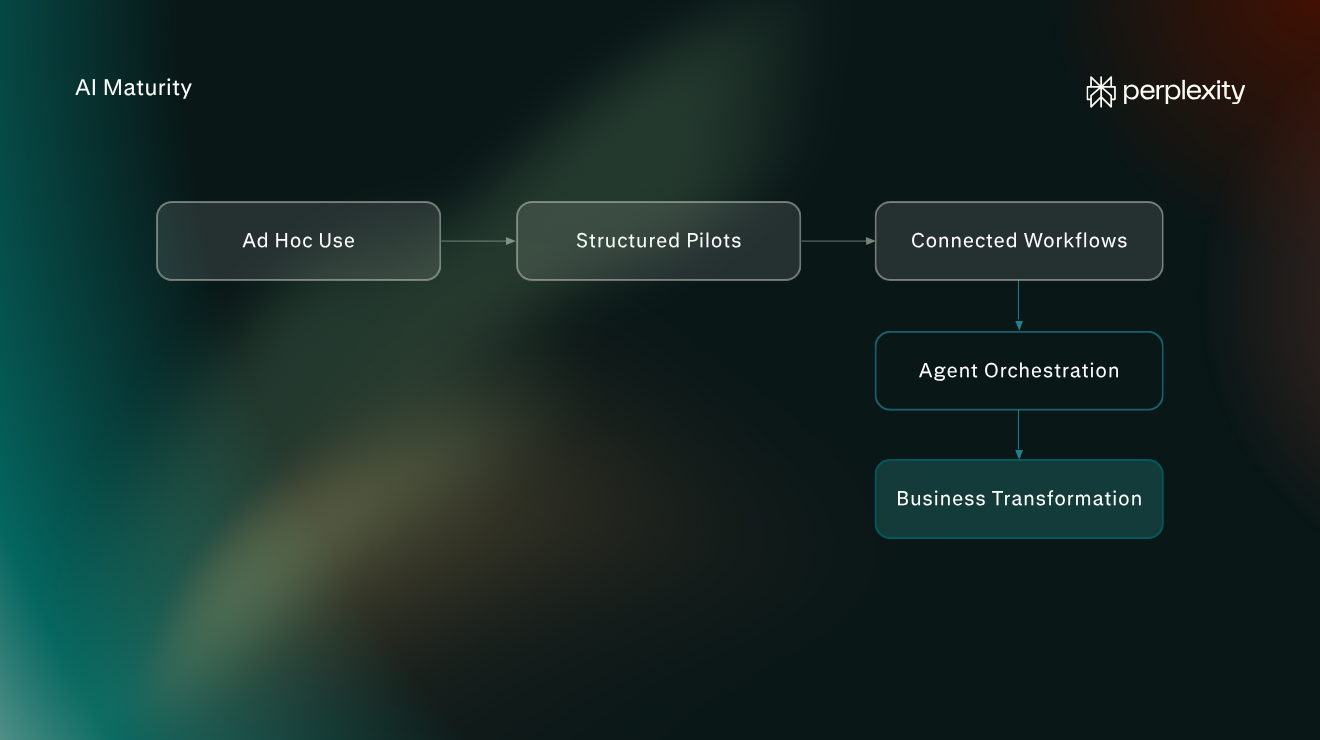
AI maturity measures how developed and deliberate an organisation's use of AI is, beyond simply having AI tools in place. Most frameworks describe this as an AI maturity model, moving from early, unstructured experimentation to full AI integration.
At the earliest stage, a handful of employees use AI on their own initiative. Nobody has approved it or trained anyone on it. Results are inconsistent, and the work rarely gets reused by anyone else.
At the next stage, teams run structured pilots. A department picks a specific task, runs it with AI, and measures whether it worked well. Inteleos, a nonprofit that administers medical certification exams, introduced Perplexity Enterprise to help draft low-stakes quiz questions. Once the pilot proved out, Perplexity was then rolled out to 88% of the Inteleos team.
As companies become more AI mature, they begin to build AI tools into standard workflows and connect them to company data and systems. For example, at Paypal, teams in enterprise risk use Perplexity as part of a standard security workflow, verifying IDs by cross-referencing ownership details and flagging suspicious accounts.
And, at the most mature stage, the company has adapted their products, business model, or operations to fully incorporate AI. They may also use agentic AI systems and models that hand off work to each other. At Rox, for instance, AI is built into the product itself: agents automate parts of sales research and CRM maintenance, while Perplexity’s APIs supply the external intelligence that supports those workflows.
Why AI maturity matters
Personal productivity gains from AI are relatively common, reported by 80% of respondents in McKinsey's 2026 survey. But just 37% said it has contributed to their organisation's EBIT.
The difference in results seems to relate to the maturity of the company’s AI use. McKinsey's AI high performers, about 6% of respondents, attribute at least 5% of EBIT to AI and describe the value as significant.
Companies with a mature AI program share some core behaviours:
- They’ve restructured workflows around AI solutions. Nearly three-quarters of McKinsey's high performers had redesigned workflows because of AI, compared with one-quarter of other respondents.
- Senior leadership is committed to AI use. In BCG's 2025 study of 1,250 executives, nearly all of the 5% of companies with the highest AI maturity scores report deeply engaged C-suites, compared with 8% of the 60% with the lowest scores.
- They prioritise AI skills development for employees. The same top-scoring companies expected to train more than 50% their workforce on AI that year, against 20% at the lowest-scoring companies.
- They’ve introduced agentic AI solutions. McKinsey's high performers were more than 3 times as likely to be scaling agents in most business functions.
AI maturity: popular frameworks
Gartner's AI Maturity Model bases their assessment of an organisation's maturity on how well AI is integrated into their processes. It scores an organisation separately across seven areas: strategy, data, governance, engineering, operating model, culture and AI value. Organisations are then grouped into one of five stages:
- Foundational: Experimental use, little coordination
- Emerging: Early pilots run, some executive interest
- Operational: AI used in business processes
- Scaled: AI used across multiple functions, delivering measurable ROI
- Transformational: AI influencing decision making and operating models, delivering meaningful competitive advantage
Deloitte's AI automation maturity model measures maturity specifically by how deeply agents are built into a company's processes.
- Level 1: Standard automation with no agents involved.
- Level 2: Basic automation, agents introduced into existing processes.
- Level 3: Processes actively redesigned around what agents can do.
- Level 4: The organisation itself is restructured around AI capability.
Google Cloud's AI Adoption Framework tracks maturity across three phases.
- Tactical: Simple, narrow AI use cases, often without a coherent plan for what comes next.
- Strategic: AI delivers sustainable business value, with several systems deployed and maintained in production.
- Transformational: AI is central to the organisation, driving innovation and supported by a structure for scaling it further.
It also breaks maturity into six themes, each formed where two core areas, people, process, technology, and data, intersect.
- Learn: the quality and scale of programmes to build AI skills.
- Lead: whether AI work has backing from leadership and coordination across teams.
- Access: how easily data and AI assets can be shared and reused across the organisation.
- Scale: whether cloud-native services can handle AI workloads at real volume.
- Secure: how well data and AI systems are protected and responsibly governed.
- Automate: how reliably AI systems run in production.
While the frameworks differ in terms of focus and measurement, they portray the same maturity journey: unstructured experimentation, then pilots with leadership support, then AI built into daily work, and finally AI reshaping the organisation itself.
AI maturity: common blockers
Four obstacles tend to get in the way of AI maturity in organisations. Here’s how to address them:
1. Data Quality
When introducing cross-functional AI pilots, choose a first AI use case, then identify the one or two data sources it relies on. Make sure that those sources are:
- Organised: keep only the records the use case needs, in one place.
- Accurate: remove duplicates, fix outdated records, and check for errors.
- Owned: name a person who keeps the data accurate and decides who can change it.
Add more data sources only after the first ones produce reliable answers. Define shared terms, such as what counts as an active customer, in one place the AI tool reads from.
2. Skills
Put a recurring block on the calendar, daily or weekly, for people to practice AI on their own work, alone or in a group. Teach employees how to check AI sources and evaluate its output.
Before rolling out a new AI workflow, ask the people who do that task to write down the steps, try the AI version, and say where it falls short. Connect AI to tools already in use, and test with a few users before a wider rollout.
3. Governance
Clear rules about tools, data, and review let AI use grow and scale rapidly without adding risk. Publish a short list of approved tools and require company sign-in. Set data tiers that say which kinds of data can go into which tools.
Decide how much human review each type of work needs, sorting each AI-assisted workflow into one of three categories: AI owned, human reviewed, or human owned. And keep a log of which AI tools were used for which work and who reviewed the output, so a mistake can be traced back to its source and corrected.
4. Business value
More than 60% of the companies with the highest maturity scores rigorously track AI value, compared with 17% of stagnating companies, BCG found. Pick one measurable workflow and record the baseline: time, cost, and error rate. Set success criteria and a decision date before the pilot starts. Track cost per use from day one, and scale only after results beat the baseline.
AI maturity: a glossary
AI adoption: The extent to which AI tools are being used. This is often used interchangeably with AI maturity, but the two are different: maturity refers to the systematic use of AI across an organisation. Adoption just means how many people are using it.
AI readiness: Whether the infrastructure and data are in place to use AI well. An organisation can have clean data and solid infrastructure and still lag in maturity, if it hasn't adjusted how it operates around AI's capabilities.
AI maturity: How deliberately and effectively AI is being used. Adoption and readiness make maturity possible but don't guarantee it.
AI governance: The rules and processes that determine how AI gets used responsibly inside an organisation, who approves new use cases, and what gets reviewed.
Agentic AI: AI systems that can take action on their own and execute multi-step tasks, rather than only responding to a single prompt.
Orchestration: Running multiple AI agents, where one can hand off part of a task to another, instead of using each one in isolation.
AI maturity: Quick self-assessment
Answering a few questions can give any employee a rough sense of where their organisation sits.
Questions to ask | |
Strategy |
|
Data |
|
Governance |
|
Technology |
|
Talent |
|
Where Perplexity fits in
Perplexity Computer supports the journey toward organisational AI maturity by bringing 20 advanced models into one system, covering research, analysis, content, and code, instead of running each as a separate tool. It routes work between those models directly, the kind of orchestration that marks the more advanced stages of maturity.
FAQs
What is an AI maturity model?
A framework that scores an organisation's AI capability and assigns it a level based on how developed and deliberate its use of AI is.
What are the stages of AI maturity?
Most frameworks describe a similar arc: unstructured experimentation, then structured pilots, then AI built into daily workflows, then AI running across the organisation with autonomy.
How is AI maturity different from AI adoption?
Adoption measures whether AI tools are being used at all. Maturity measures how effectively they're being used.
What's the difference between AI maturity and AI readiness?
Readiness measures whether the infrastructure and data are in place to use AI well. Maturity measures whether the organisation has actually built its operations around that capability.
What does AI governance mean?
The rules and processes that determine how AI gets used responsibly inside an organisation, including who approves new use cases and what gets reviewed before deployment.
What is agentic AI?
AI systems that can take action on their own, carrying out multi-step tasks rather than only responding to a single prompt.
What is AI orchestration?
Running multiple AI models or systems together, so one can hand off part of a task to another, instead of using each tool in isolation.
How can an organisation improve its AI maturity?
By moving past isolated experimentation toward structured pilots with clear ownership, then connecting AI to real data and workflows, and building in governance for where AI can act without review.