
What Is RAG as a Service (RaaS)? Definition, Use Cases, and Top Providers
RAG as a service (RaaS) lets companies outsource the indexing, storage, and retrieval behind retrieval-augmented generation, and this guide covers how it differs from self-hosted RAG, its main enterprise use cases, and seven leading providers.
Retrieval-augmented generation (RAG) has become central to how enterprises use AI. By providing LLMs with information not contained in their training parameters, RAG improves the accuracy and completeness of generated outputs.
RAG as a service is the full outsourced management of RAG systems. Rather than build a system internally, companies instead connect their AI platform to a vendor service that handles indexing, storage, and retrieval. This is often the most cost-effective and secure way to incorporate RAG into enterprise workflows.
What is RAG as a service (RaaS)?
RAG as a service, often abbreviated to RaaS or RAGaaS, is an approach to using RAG in which components and processes are either substantially or wholly outsourced. It is most commonly used to refer to a fully managed service.
It shares the basic conceptual template as software as a service (SaaS). Instead of hosting backend infrastructure in a local environment, RAG architectural components like vector databases, embedding models, and retrievers are hosted and managed by a third-party provider.
Its use cases are largely in the enterprise space. Because companies often have extensive knowledge bases, databases, and repositories of sensitive information, it makes sense for them to use a trusted third-party rather than build a system from scratch.
The vendor will often handle all aspects of ingestion, data storage, security, and ongoing RAG optimization. They can also provide access to an LLM and user interface (such as an embeddable widget for a company app) as part of the service or, alternatively, connect to a company’s existing AI system.
Differences between local RAG, cloud RAG, and RAG as a service
In reality, most RAG systems rely on vendor services to some degree. The complexity inherent in even basic implementations of RAG means that it is rarely feasible to build everything from the ground up.
While many RAG systems use external services, however, that doesn’t mean they all classify as RAG as a service. The core distinction lies in who builds and manages the system. For RaaS, the vendor manages most, if not all, of the underlying infrastructure. The enterprise is only required to provide access to their database or cloud storage.
Here’s an overview of what separates RaaS from other types of RAG:
- Local RAG: The user builds applications for ingestion, retrieval, and storage on their own servers. They may even run the embedding and large language models locally.
- Self-build RAG using cloud services: A hybrid approach in which the administrator uses APIs to connect to key RAG components like hosted databases and third-party models. Connections and the orchestration layer are managed internally.
- RAG as a service: A provider manages all or most of the RAG system. They may connect to the company’s existing AI interface and model or provide them as part of a paid package.
It’s also worth mentioning that companies don’t always take an either-or approach to RAG as a service. They may design their own systems for straightforward use cases and enlist a third-party provider for more advanced applications.
Example of RAG as a service: Enterprise knowledge management
Enterprise knowledge management is one of the most prevalent examples of RAG as a service. In a simple case, users have access to an AI chatbot that can answer questions about confidential company and customer information.
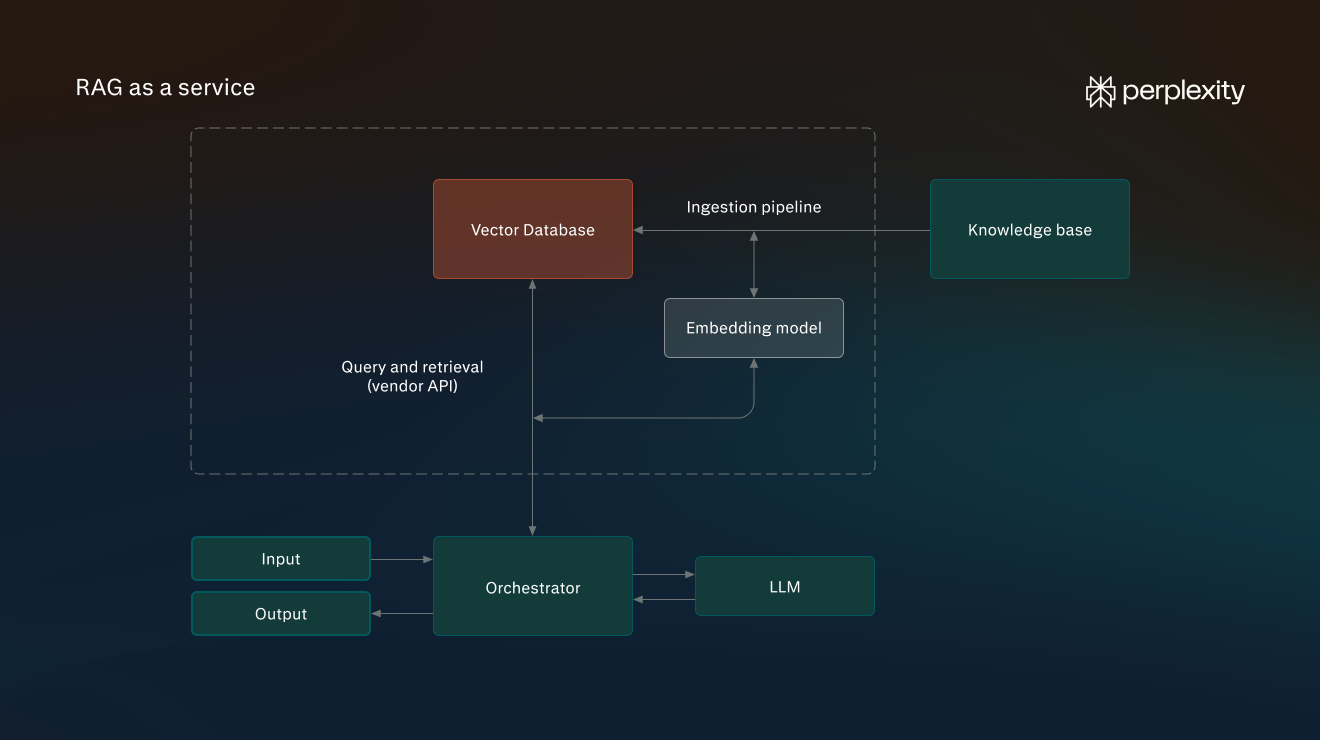
Here’s an overview of what a RaaS system for knowledge management could look like:
- A company builds an internal knowledge base. In a simple scenario, this might be a collection of files in the cloud containing information about policies, standard operating procedures (SOPs), product information, and common customer FAQs.
- A third-party RaaS provider is given access to this knowledge base via API. It cleans all relevant text and converts passages into vector embeddings using an embedding model and stores them in a vector database on its servers. This series of steps is called the ingestion pipeline.
- Whenever new documentation is added to the knowledge base in its raw form, it is retrieved and added to the vector database by the provider.
- The provider also connects to the orchestrator of the company’s AI system via the vendor’s retriever API. The orchestrator is the software component that coordinates user inputs and sends augmented prompts to the LLM.
- Whenever a user prompts the company chatbot, the orchestrator passes the query text to the vendor. The vendor converts the query into an embedding, which is then used to search the database.
- The orchestrator receives the additional information and augments the input context and sends it to the LLM.
- The LLM generates an output that the orchestrator delivers to the user via the company chatbot.
Benefits of RAG as a service vs. self-hosted RAG
RAG as a service has the following benefits compared to self-hosted RAG:
- Faster deployment: Pre-built components handle document parsing, chunking, embedding, storage, and retrieval.
- Less maintenance: Using a vendor eliminates the maintenance and security burden that would otherwise fall on a company’s dev team.
- Scalability: Although vendors do impose service and package tier limits, third-party RaaS is usually a cost-effective way to deal with expanding knowledge bases.
- Up-to-date content syncing: The database on the vendor side automatically updates whenever new documents are added.
- Integration with enterprise platforms: Managed RAG is often integrated into general-purpose enterprise AI platforms, with ongoing optimization included.
Overview of RAG-as-a-service use cases
RAG itself has a wide range of use cases and examples in both the consumer and business spheres. RAG as a service, on the other hand, is used mostly in enterprise contexts.
Here is an overview of the main RaaS use cases:
- Internal knowledge management: Many companies now embed chatbots in their software so employees can search internal documentation stored on cloud services like Google Drive, SharePoint, Confluence, and so on. RaaS provides the layer that ingests, stores, and queries these files.
- Customer support: In these systems, customer-facing chatbots and assistance bots used by representatives provide access to company documentation. Dedicated platforms like Zendesk and Intercom typically offer their own out-of-the-box RAG-based chatbots.
- Sales enablement and assistance: Companies often have vast troves of customer information that can assist with sales. Examples include customer support tickets, competitor research, and unstructured recordings of calls. As with customer service, leading sales platforms like Gong and Pipedrive often offer RAG functionality as part of their enterprise packages.
- Customer data access: AI is increasingly being used to assist with, or in some cases completely automate, tasks like subscription management, returns, and changes to personal details. In these cases, security is paramount, and RAG-as-a-service providers prioritize data safety.
- Customer chatbots: Customer-facing AI chatbots connect to backend product databases to assist with discovery and technical queries. This use case often requires advanced architecture because customer queries can span a large range of informational requests. For smaller ecommerce sites, RAG as a service provides a straightforward means of implementing this functionality on their websites and in their apps.
Top 7 RAG-as-a-service providers
RAG as a service providers usually fall into one of two camps. They are either general-use AI platforms with built-in RAG functionality or vendors that offer managed backend RAG infrastructure.
A general solution will work out of the box and typically connects to other apps and external data sources through integrations. More modular solutions can be a better option for tailored setups.
1. Perplexity
Perplexity Enterprise is a comprehensive suite of agentic tools that includes advanced RAG functionality for building internal knowledge bases (including at the level of individual projects) and running web search. It offers access to most generative models from leading providers and has a proprietary embedding model.
Perplexity also has a large library of integrations that can connect to external data sources for information retrieval. Enterprise-level data security and employee permissions are designed to safeguard sensitive internal information.
Core features: Knowledge bases, multi-model access, third-party integrations, enterprise-level security
2. Amazon Web Services
Amazon Web Services (AWS) provides RaaS through its Bedrock Managed Knowledge Base service. Users provide data sources, and Amazon handles all aspects of ingestion, data storage, and retrieval. The service includes a reranking model.
Core features: Knowledge bases, hybrid search, managed embedding model, support for agentic retrieval
3. OpenAI
OpenAI provides access to RAG infrastructure via its Responses API and file_search tool. Users can upload documents, which are chunked and converted to embeddings and stored in hosted vector databases. The Responses API is a relatively straightforward way of adding RAG functionality to an existing app.
Core features: Hosted knowledge bases, vector search, semantic search, LLM integration
4. Microsoft Azure
Azure AI Search is Microsoft’s core RAG offering and acts as an indexing, vector storage, and hybrid retrieval engine (keyword, semantic, and vector search). Microsoft Foundry is a closely related product that functions as the orchestration layer in conjunction with AI Search, but developers can also integrate with their own platforms.
Core features: Data ingestion, multimodal search, reranking, enterprise-level security
5. Pinecone
Pinecone Assistant provides automated chunking, embedding, retrieval, and reranking. It is designed to enable companies to deploy AI assistants that have access to proprietary knowledge bases without building a dedicated retrieval pipeline. It works with other Pinecone products, such as Pinecone Database and Vector Nexus, a RAG-like solution designed to reduce consumption costs.
Core features: Out-of-the-box indexing and retrieval architecture, integration with other enterprise Pinecone services
6. LlamaIndex
LlamaIndex is an open-source framework for connecting data sources to LLMs. It works well with complex documentation and offers specialized index structures. Managed RAG-as-a-service packages that run on the open framework are available. Its extensive modular functionality and wide set of integrations with other tools make it a good option for more complex RAG implementations.
Core features: Managed RAG service, integration with external vector databases, complex document parsing
7. Vectara
Vectara is available as both a SaaS and on-premise solution and provides access to a complete RAG ingestion, retrieval, and storage system. It has received praise for its hallucination controls and uses its own retrieval and generative models, though it also connects with third-party ones. It combines ease of implementation with a high degree of customizability.
Core features: End-to-end managed RAG, factual accuracy controls, proprietary models
Should you use RaaS or build your own system?
Deciding between a RaaS provider and your own self-hosted RAG system comes down to three factors: cost, scale, and complexity.
Building a RAG system from the ground up, especially if it uses in-house or fine-tuned models, usually represents a significant development investment. If you’re running all components on your own servers, you may sidestep the issue of token and storage costs, but this can easily be offset by the price of hardware and maintenance over the long term.
RaaS is also a better option if you anticipate scaling your AI workflows, either because the company is growing or you plan to extend beyond a limited number of use cases. If you have well-defined usage boundaries, a self-hosted system may be more suitable.
Finally, RAG can be complex from a development standpoint. More advanced architectures that incorporate multimodal and hybrid retrieval, along with orchestrator or LLM-level tasks like reranking, require advanced expertise to implement. Typically, a specialized vendor will provide the most economical access to these types of functionality.