

Overview
Audit Logs are available to Enterprise organizations with 50 seats or more, or with at least one Enterprise Max seat. Administrators can use them to investigate activity and monitor administrative changes. You can receive events through a webhook, retrieve stored events through the Audit API, or use both. The API does not require a webhook and does not change an existing webhook configuration.Choose how to access audit logs
Table 1: Webhook delivery and Audit API retrieval.
For events available through both methods, the API returns the recorded event metadata, including query text, answer text, and file names where present. Query and answer text is limited to the first 500 characters in both methods. Thecomet_agent_action exception described in this article also applies.
The payloads are not completely identical: the API uses different top-level field names and redacts credentials in certain webhook-setting changes. See Data privacy and security for the scope of that redaction.
The webhook is the faster delivery path. The API has no guaranteed freshness interval. Do not treat it as a guaranteed complete copy of the webhook stream.
Audit Logs do not capture every action. Neither method records seat-tier changes made through SCIM, which synchronizes membership with your identity provider, or through bulk tools. Member additions and removals made through CSV bulk operations are also excluded.
Before you start
- Confirm that your organization meets the seat requirement above.
- Ask an administrator with organization settings access to enable logging.
- To manage API keys, use a role with both View audit logs and Perplexity API access. Built-in administrators have both permissions; custom roles can be granted both.
- Confirm that API key creation is enabled for your organization. If it is not enabled, contact your account team to request access.
- For webhook delivery, prepare an HTTPS endpoint and an authentication value.
Data privacy and security
Both methods can contain personal information and recorded content, not just activity identifiers. Depending on the event, metadata can include query and answer text, file names, target member emails, organization-setting values, and Perplexity Computer task details. For webhook authentication-token changes, the API replaces the recorded old and new token values with[REDACTED]. For webhook URL changes, it removes credentials and the URL path, query, and fragment while retaining the destination origin when possible; cleared values remain identifiable as cleared.
These redactions apply to API responses for those webhook settings, not to webhook delivery or stored events. They do not remove other recorded personal information or content from API metadata.
Restrict access to collected logs according to your organization’s privacy policies. Keep webhook URLs, authentication values, and API keys confidential, and revoke keys you no longer need.
For Enterprise-wide data practices, see Data retention and privacy for Enterprise organizations. The Trust Center provides security and compliance documentation, and the Data Processing Addendum sets out contractual data-processing terms when incorporated into your agreement.
The session and file deletion settings in Data Retention for Enterprise do not define Audit API retention. Treat your organization’s retention policy for exported logs separately from Perplexity’s storage of audit events.
A retention period for Audit API events is not specified here. Collect events promptly and retain copies according to your organization’s policy; ask your account team to confirm the applicable retention terms.
Enable audit logs
- Go to Organization Settings.
- Open Data and privacy.
-
Under Audit Log Settings, turn on Enable Audit Logging.
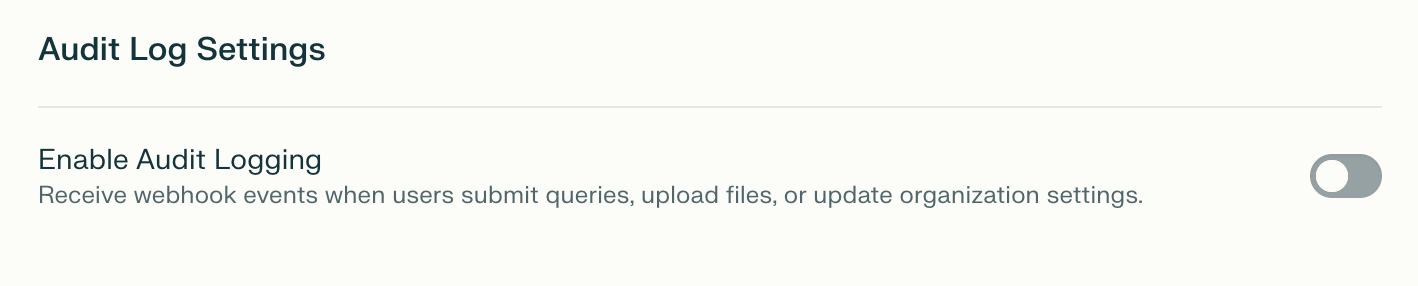
Figure 1: The Enable Audit Logging control in Audit Log Settings.

-
Enter your HTTPS endpoint in Webhook URL.
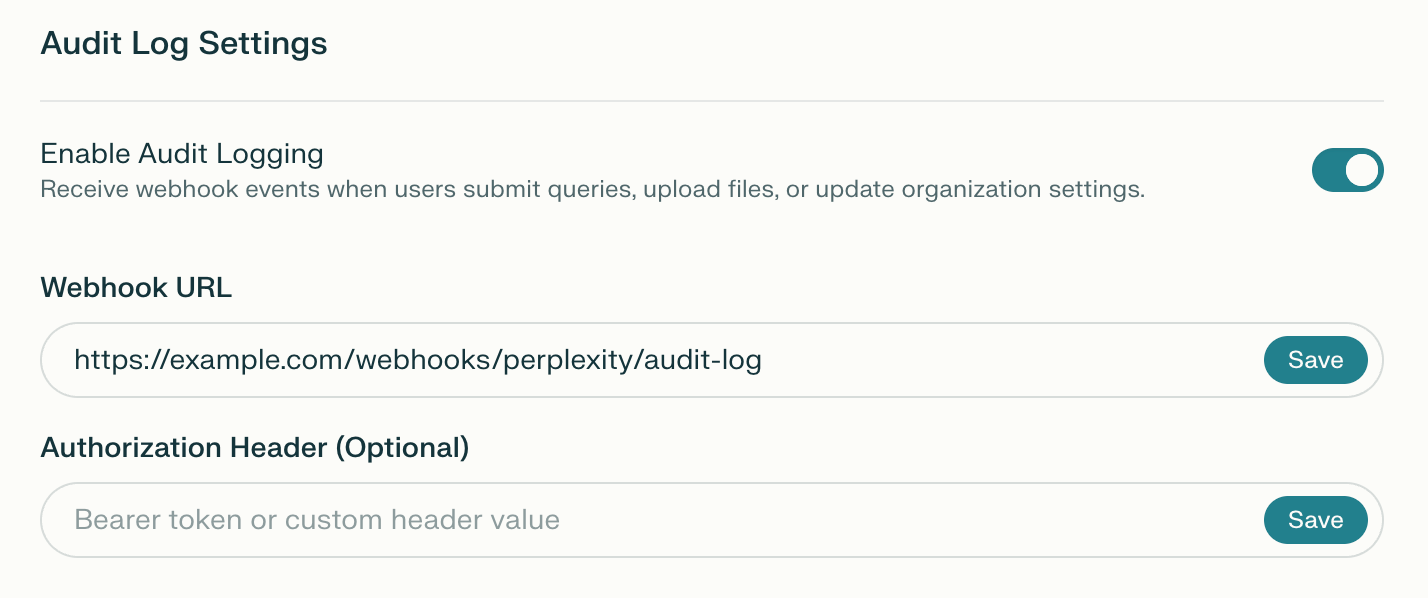
Figure 2: Webhook URL and Authorization Header settings.
- Click Save beside Webhook URL.
- If your endpoint requires authentication, enter the value in Authorization Header.
- Click Save beside Authorization Header.

2xx response.
Query audit logs with the API
Use the read-only Audit API to retrieve stored events for investigations or ingestion into a security information and event management (SIEM) system. You control when your integration requests events; no inbound webhook endpoint is required.Create an Audit API key
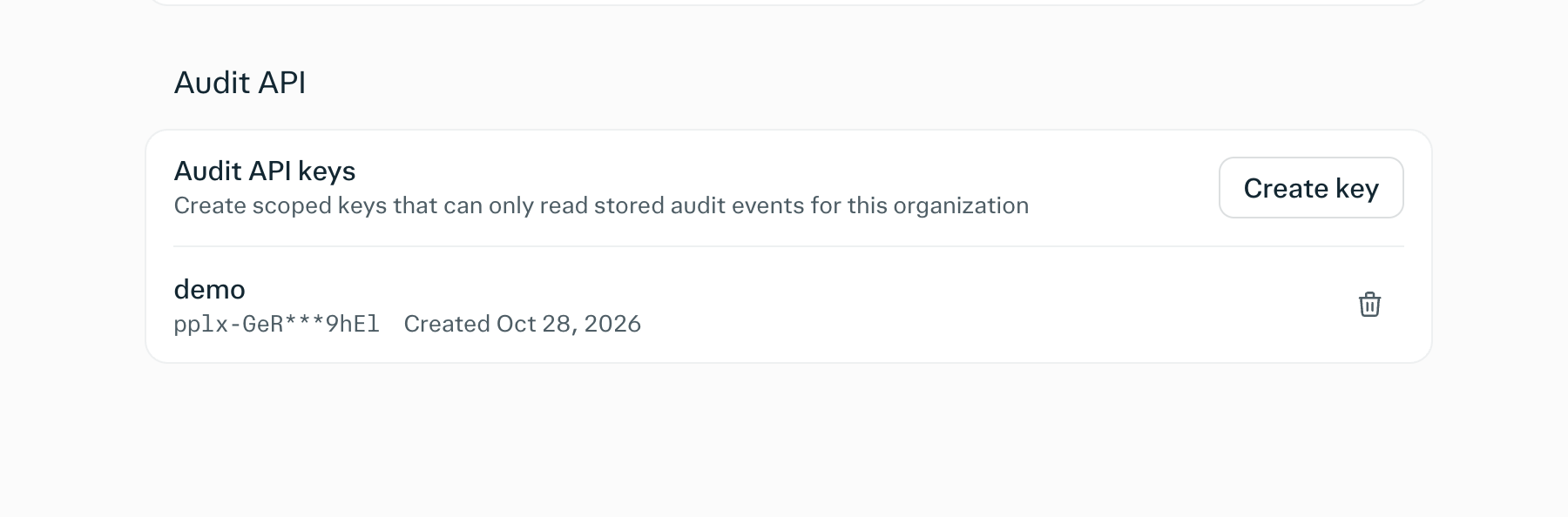
- Go to Organization Settings > Enterprise APIs and find the Audit API section.
-
Click Create key.
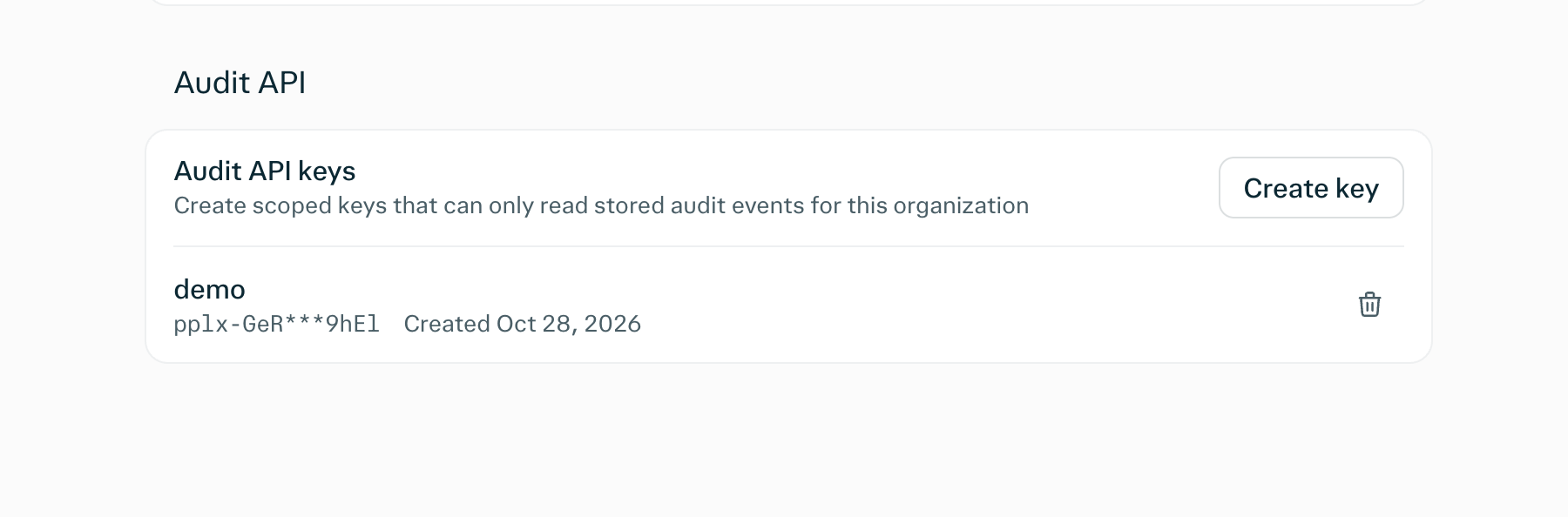
Figure 3: Audit API key controls in organization settings.
-
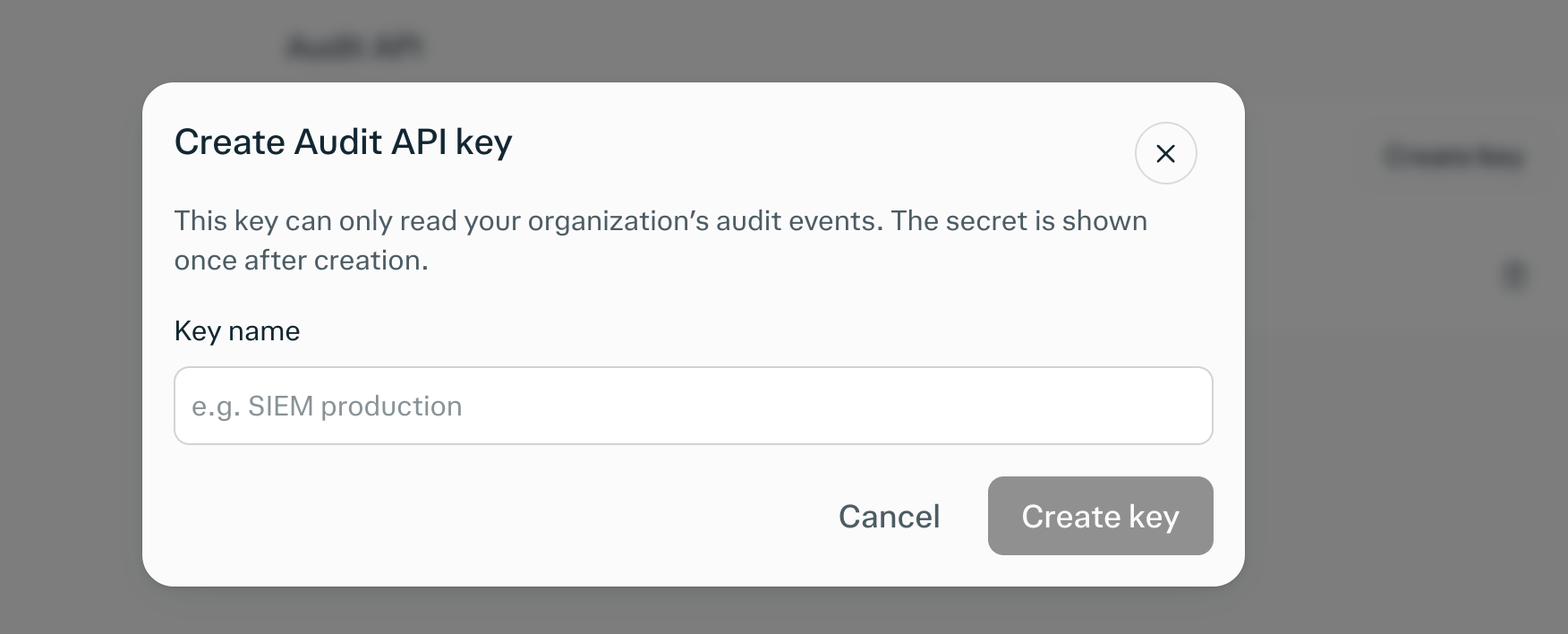
Enter a Key name, such as
SIEM production.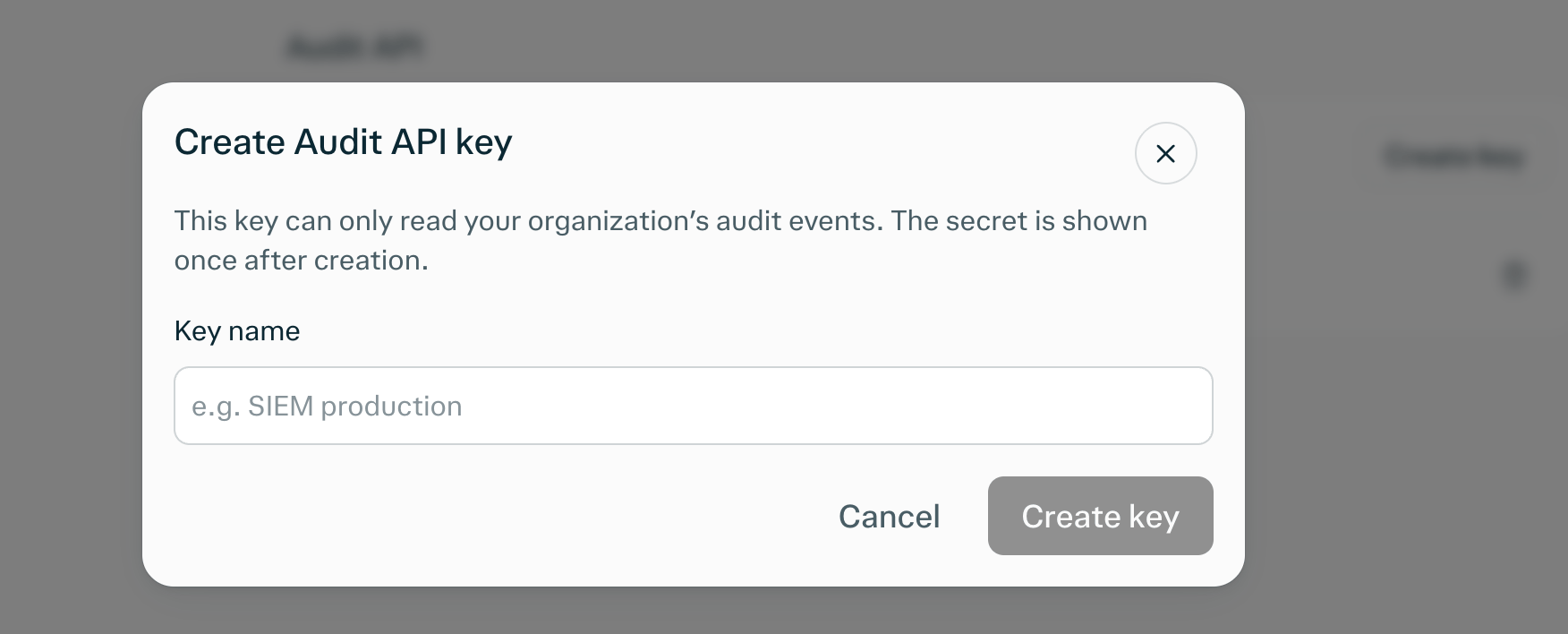
Figure 4: Name an Audit API key before creating it.
- Click Create key.
- When API key created appears, copy the secret.
- Store the secret securely. It is shown only once.
Connect your integration
Use your Audit API key to authenticate your integration. Each key can read only its own organization’s audit events and cannot call model APIs. See Audit API for the endpoint, authentication examples, request parameters, response fields, pagination, rate limits, and errors. Use that developer reference when building or maintaining a collector. A request can use eitherafter_id or before_id, but not both.
Content and event coverage
API metadata uses the event-specific fields stored for API retrieval, which can differ from webhook metadata, including forcomet_agent_action as described below. Values can include text, nested objects, names, and email addresses; the fields present depend on the event and what was recorded. Some events have no metadata.
The shared metadata does not make the API and webhook envelopes interchangeable, or guarantee that every action is captured. The credential redaction applies only to the API; the text limits and recording gaps apply to both methods.
For comet_agent_action, API metadata contains only action when recorded. The url and action_params fields are sent only through webhooks and are not stored for API retrieval.
Each successful API read creates an audit_events_accessed event that is available through the API, not the webhook. Request that event type explicitly when reviewing access; it is excluded from the default API feed.
Data availability
Available history begins when your organization enabled audit logging, with no backfill of earlier activity. Stored history does not extend earlier than July 16, 2026.How to verify it worked
Use the request example in Audit API to confirm that your integration receives a successful response. An empty event list can mean no events match the selected window and event type; it does not by itself indicate an authentication failure.Webhook authentication
You can secure your webhook endpoint with a Bearer token or a complete authorization value. Configure the value your receiving endpoint expects.Bearer token
Provide a token without a prefix, such asYOUR_WEBHOOK_TOKEN. Perplexity prepends Bearer and sends Authorization: Bearer YOUR_WEBHOOK_TOKEN.
Custom authorization header
Provide a complete authorization value that includes its scheme. For example,Splunk YOUR_HEC_TOKEN is sent as Authorization: Splunk YOUR_HEC_TOKEN.
Webhook delivery
Request format
Perplexity delivers audit logs to your webhook URL as HTTPPOST requests. The request body uses application/json.
Authentication header
If you configured an authentication value, Perplexity includes it in theAuthorization header. See Webhook authentication for Bearer and custom-scheme formats.
Response handling
Your webhook endpoint should return an HTTP2xx response to acknowledge receipt within 1 second. Perplexity records delivery errors, including HTTP 4xx and 5xx responses, but does not automatically retry failed or timed-out deliveries. Monitor your receiving endpoint for failures and missing events.
To recover a missed delivery, query the API for events in the affected period. Recovery is limited to events that were successfully stored and are still available; the API cannot reconstruct events that were never recorded.
Webhook audit log schema
Webhook events use the fields below. For the API’s different top-level field names, see Audit API; the metadata comparison is covered in Query audit logs with the API.Table 2: Webhook payload fields.
A required string field can be empty when a value is not recorded. Do not assume that everyip_address value is an IP address.
Event types
The following tables describe documented webhook event types, not a guarantee that every action is recorded or every type is available through both methods. For events available through both methods, the API returns the recorded metadata subject to the redactions described above. Thecomet_agent_action exception described in this article also applies.
User activity events
Table 3: User activity events.
Query events can includemetadata.attachments, with file_uuid and file_name for each attached file. Both methods can return these nested fields when recorded.
Thread events
Table 4: Thread events.
Membership events
Table 5: Membership events.
Organization events
Table 6: Organization events.
Role and group events
Table 7: Role and group events.
Forrole_users_changed and role_groups_changed, metadata can include an action value of added or removed. Use this field to distinguish the direction of a membership change.
Comet agent events
Table 8: Comet agent events.
Connector events
Table 9: Connector events.
Computer events
Table 10: Computer events.
Webhook payload example
This illustrative JSON payload represents a query event delivered to a generic webhook. It is not an Audit API response.Platform-specific formatting
Slack webhooks
For a webhook URL beginning withhttps://hooks.slack.com, Perplexity uses Slack’s Block Kit format. The blocks array contains sections for the event type, member and client details, and event metadata when present.
Event type labels use title case with underscores removed. Slack formatting truncates individual metadata values at 500 characters and the metadata section at 2,500 characters, with a truncation notice for long values.
Splunk HTTP Event Collector
When the authorization value starts withSplunk, Perplexity wraps the payload in an event object for Splunk’s HTTP Event Collector (HEC). This illustrative example shows the wrapper:
Generic webhooks
For other webhook destinations, Perplexity sends the standard JSON payload without a platform-specific wrapper. See Webhook payload example for the format.Common webhook scenarios
Track research sessions
Usesession_id to correlate a query with its answer. These steps use webhook field names; API top-level field names differ even when the event metadata matches.
1
Find the query event
Read
query_str in the event’s metadata. Record its session_id to find related events.2
Match the answer event
Find the
answer_generated event with the same session_id. When recorded, answer contains up to the first 500 characters of the answer, alongside the model used.Monitor file access
Use file identifiers to correlate uploads and downloads. Both methods can include recorded file and Project details in event metadata.1
Find the file upload
Read the upload event’s
file_uuid. Record the identifier for comparison with subsequent events.2
Match file downloads
Find download events with the same
file_uuid. Use the actor and timestamp fields to see who accessed the file and when.Audit configuration changes
Fororganization_settings_update, the setting key identifies what changed. Both methods can include old_value and new_value; the API redacts credentials in the webhook settings described in Data privacy and security.
Filter stored webhook data by user_email in your own analysis system to track which administrators made changes. The Audit API does not support a user-email filter.
Best practices
Implement your webhook endpoint
- Respond promptly: Acknowledge receipt within 1 second.
- Process asynchronously: Queue received events for processing.
- Validate payloads: Check structure and content before ingestion.
- Secure the endpoint: Use HTTPS and validate the configured authentication value.
- Monitor failures: Record receiving-end errors and investigate delivery gaps.
Store and analyze collected logs
- Set a retention policy: Keep collected logs for the period your organization requires.
- Index relevant fields: Use event type, actor, timestamp, and session fields for analysis.
- Correlate activity: Use
session_idto connect related events. - Monitor patterns: Investigate unusual access or administrative changes.
- Maintain backups: Preserve copies according to your organization’s security and privacy policies.
Troubleshooting
Table 11: Troubleshooting.
Check Audit API for response codes and collection guidance. When you contact support, include the exact error and the steps you already tried. Also include the API request time or the time of the affected webhook event or delivery failure, with its timezone. Omit keys, tokens, authentication values (including full authorization headers), and sensitive event content.Frequently asked questions
Can I use Audit Logs with fewer than 50 seats?
Yes. An organization with fewer than 50 seats can access Audit Logs if at least one seat is on the Enterprise Max plan. See What is Enterprise Max? for eligibility.What if I enabled Audit Logs by mistake and see an unexpected charge?
Contact your account team or Help > Contact Support to review the charge and any refund eligibility. See Refunds; disabling Audit Logs is not a promise of a billing reversal.Related references
- Audit API
- Enterprise roles and permissions
- What is Enterprise Max?
- Data retention and privacy for Enterprise organizations
- Data Retention for Enterprise